
Buckley!
An Architect of Our Era

Is William F. Buckley, Jr., an architect of our era? Is he a kind of founding father? Are national leaders marching to the beat of his drum?
In many respects, you could say an emphatic “yes” in response to all three questions. I am going to emphasize Buckley’s views about higher education here, and the massive influence of those views on current developments. But his influence is much broader than that, and I will say a few things about his persona, which was essential to his enduring impact.
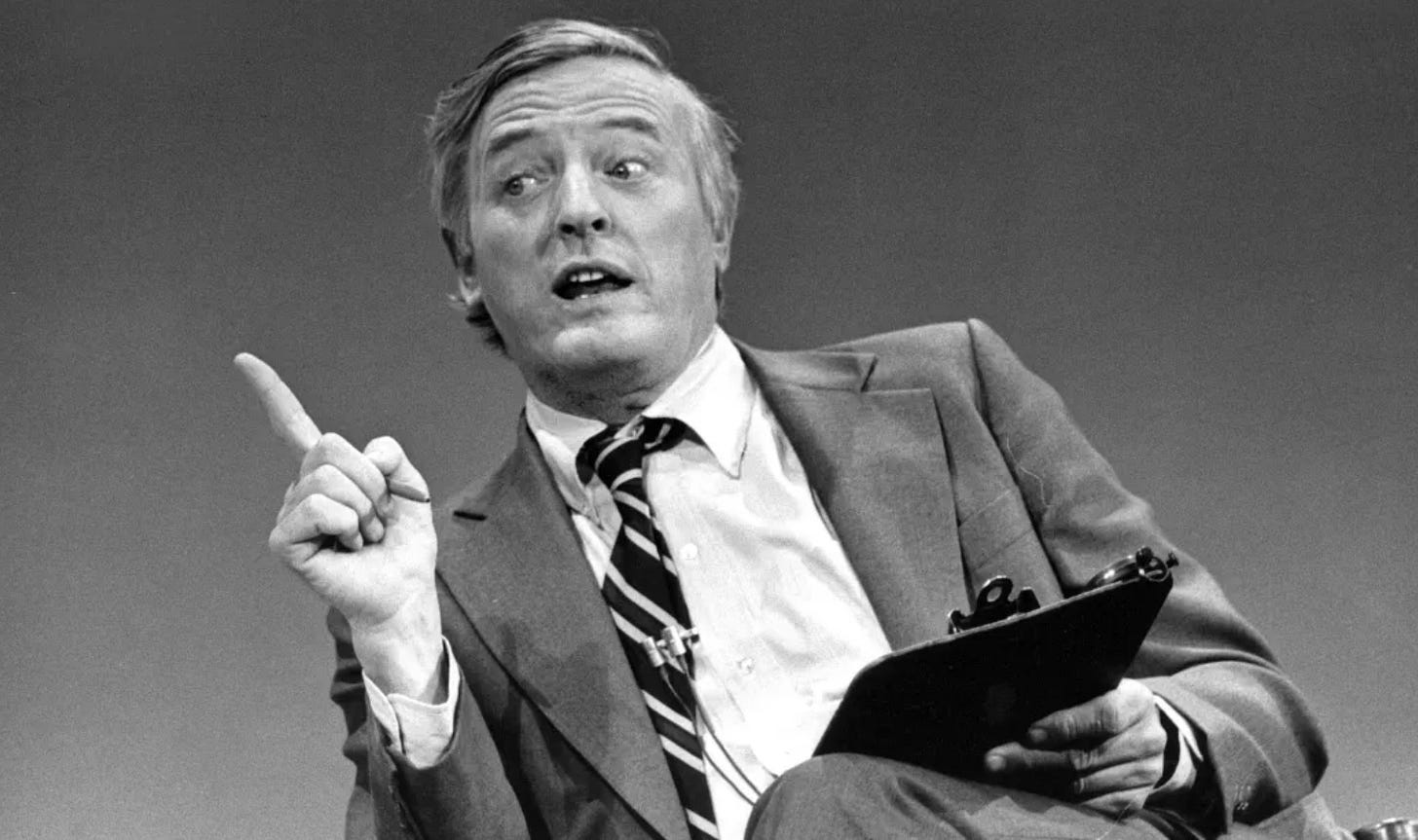
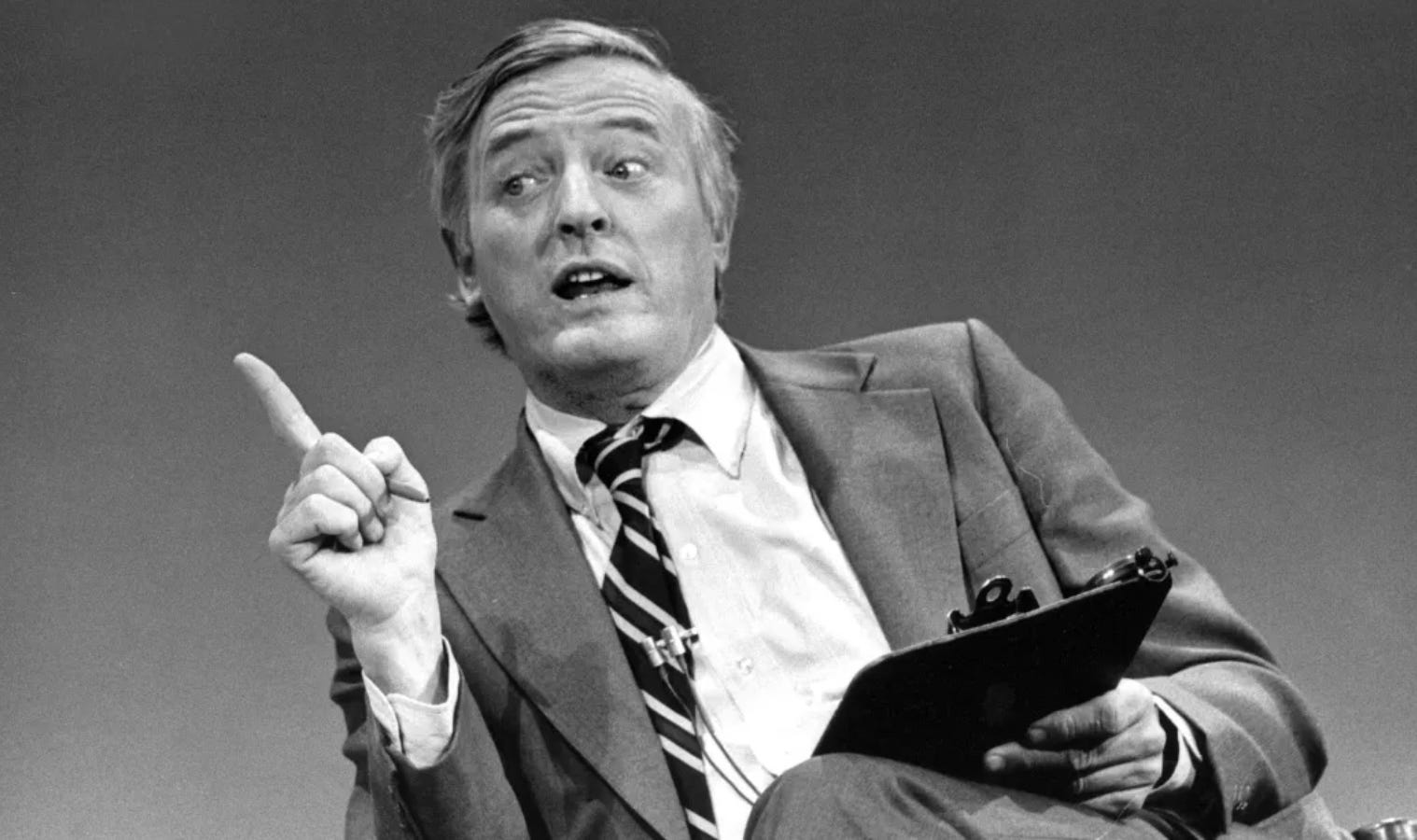
I was about fourteen, I think, when I first encountered Buckley; it might have been his television show, Firing Line, or it might have been from some of his writing. My gosh! He was full of charm. He was dashing. He used words with many syllables, and he did that with delight and a sense of mischief. He was cool. He was fun. He was quick. His mind was like a knife. He seemed to know everything. He was supremely confident, and he was hilariously funny. He was disarming. He seemed to flirt with the people whose arguments he was dismantling. (Actually he seemed to flirt with everyone. Watch him with Clare Booth Luce?) Here’s a photo that captures something about him:
My parents got me a subscription to National Review, his magazine, and I felt that I was part of a club — a club of rebels, cool kids, free-thinking, independent, in the know.
Before that, I had loved Marvel Comics - The Fantastic Four, Spider-Man, the Hulk, Thor, The Avengers, Daredevil - and then too, I felt part of a similar club; we were rebels with a cause. The sensibility of National Review, in those days (and now?), felt a lot like the sensibility of Stan Lee’s Marvel. There was a ton of laughter, and plenty of winking.
To Buckley, liberals were humorless, stiff, conformists. They were a lot like DC Comics, as Marvel depicted those boring, tedious people.
From Buckley’s mission statement for National Review: “There never was an age of conformity quite like this one, or a camaraderie quite like the Liberals’.” And this: “Conservatives in this country— at least those who have not made their peace with the New Deal, and there is serious question whether there are others— are non-licensed nonconformists; and this is dangerous business in a Liberal
world.” Wow.
A nice bit of self-reflection from Buckley: “I feel I qualify spiritually and philosophically as a conservative, but temperamentally I am not of the breed.”
I wrote Buckley a letter. It must have been embarrassing, fawning, idi-
otic. And you know what? He responded. He wrote me back! I kept that
letter— handwritten, as I recall— in my drawer of sacred things.
I read everything I could find by Buckley. The world was in a struggle, I learned, between liberals and conservatives. Liberals were humorless, bumbling, and high-handed. They didn’t have a clue. Conservatives knew the secrets. They were woke. They were full of life. They had fun.
My teenage self had glimpses into these things, but I didn’t read Buckley’s first book, God and Man at Yale, published way back in 1951.
Buckley wrote it right out of college. (Yale, more specifically.) The book offered two main claims. First, Yale was hostile to Christianity. Its faculty consisted of atheists who cast contempt on religion. Second, Yale was hostile to capitalism and free markets. Its faculty consisted of socialists who looked down on the engine of national prosperity (and a fundamental location and source of freedom).
The book offered details. It asked: How could one of the nation’s greatest universities reject Christianity and reject economic liberty? How could it be so anti-American?
Buckley wanted Yale to change, and he didn’t think that Yale would change itself. Its values, he thought, were not our country’s values. Nor were they the values of Yale’s graduates. Buckley made a plea: Yale’s graduates should use their financial might to pressure Yale to reform itself.
Of course Buckley’s ultimate target was much broader. He was not focused only on Yale; his target was higher education as a whole.
All his life, Buckley was focused on young people and college students in particular. He thought that the revival of conservatism in the United States depended on them. Of course his interests were wide-ranging, but throughout his career, he was greatly concerned with what he saw as monolithic thought in higher education, and the need to do something about the universities.
Put to one side the question whether Buckley was right. There can be no doubt that the themes of God and Man at Yale helped to define a view about elite academic institutions from the year in which it was published — and that Buckley’s view is playing an especially large role today.
There is so much to say about Buckley. Sam Tanenhaus’ terrific new book on him, decades in the making, says a lot of it. I have to confess that while I admire and love the book (I am about half-way through), and I appreciate and like Buckley even more than I did before, I don’t admire his writing and his work quite as much as I expected. Sure, he was quick, and wow he could write, and he could be really, really funny. But some of the time, he was a pundit. He was a bit more of an activist and a strategist, and a bon vivant, than I expected, and he was less devoted to thinking things through than I would have thought (and than I did think, way back in teenage years).
Here’s another way to put it. With respect to politics, Buckley was willing to skim surfaces, and at times (especially early on), he had a Manichean sensibility.
But let’s end on a positive note. In life, Buckley was not Manichean at all, and he went beneath surfaces. What you could see on television, and what I saw way back in the 1960s, was what you could find in ordinary life. He liked people; actually he delighted in them. He connected with them. He wanted to make them laugh, and he liked it when they made him laugh. He didn’t hold their beliefs against them. He had a rare gift for friendship, and he cherished and kept his friends. (He hated losing a friendship, and he almost never did.) And he was not only full of zest; he was also a kind and good person. (Of course none of us is perfect.)
Was that a secret to his success, as a human being and as a public figure? I think so.
Maintaining friendships is an undervalued life skill. My mother is good at keeping hers, but I am not so much. From personal experience, social capital is in dialectical relationship with well being.
I foolishly just realized JD Vance has been spouting off God and Man at Yale sans attribution. Biden plagiarized in school, yes, but the VP's taken it to a whole nuther level.