
Eating the Past
The Langoliers Are Out In Full Force

1
I was in China a few decades ago, and my host brought me to a museum in Beijng, where we came across an exhibit on Genghis Khan. I instinctively recoiled. My host looked at me with puzzlement, and I explained, “A terrible tyrant.”
He answered quickly, and with just a little edge, “Oh no, a great hero.”
I felt embarrassed, as a hoping-to-be-polite guest, and so I said, with a shrug and a smile, “American propaganda?” He smiled back, and said, with grace and firm conviction, “Oh no, Chinese propaganda.”
2
Stephen King is, of course, our Dickens (or maybe even better, because of his astonishing range). His tale, The Langoliers, is haunting, especially in novel form, but also as a somewhat cheesy but really fun tv series.
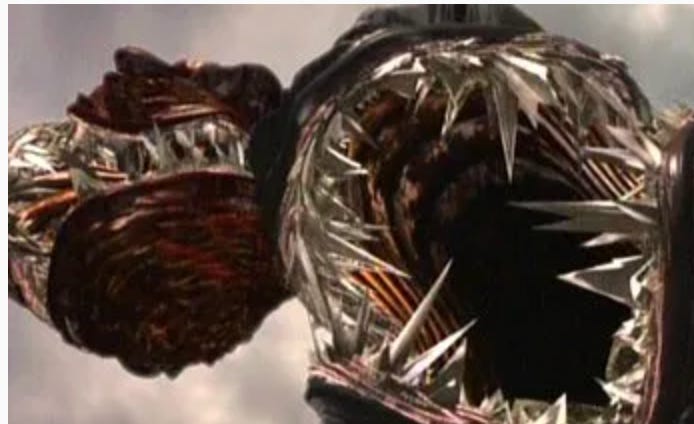
What are the Langoliers? You might well ask. They’re terrifying. They’re destructive. They’re all teeth. Here’s King, writing about the Langoliers on the loose, chasing their victim:
Then they rushed at him again, gibbering yammering buzzing whining, and he saw the frozen machine blur of their gnashing teeth and felt the hot bellows of their frantic, blind vitality in the half-instant before they began to cut him apart in random chunks.
You’ve never seen anything like the Langoliers. See now, from the tv series?
3
Here’s the plot, very briefly: King’s protagonists fly on the redeye from Los Angeles to Boston, and when they land, most of the plane’s passengers have disappeared, and everything around them seems dry and dead. There are no other people around. The air smells stale. Matches do not light. Food has no taste. Voices don’t travel. It’s otherworldly. They are alive, for sure (for sure?), but where they are is a complete mystery. It’s not real, not quite.
Eventually they discover that they are trapped in some slice of the past. Time is frozen. They are not in a place that is moving as time moves. Everything is decaying, just as the past decays.
And what about The Langoliers? They are the creatures, or the entitles, that eat the past. They destroy it. They consume it, and thus annihilate it. King’s protagonists have to find a way not to be killed by the Langoliers, by returning to a time when, well, time moves.
The story (especially) and the tv series have a lot of energy, but what makes them haunting and memorable is this idea: Monsters eat the past.
4
There is a link there, or at least a psychological link, with George Orwell’s 1984, where monsters also eat the past. You could even say that that’s what the novel is about. A defining bit:
The past was alterable. The past never had been altered. Oceania was at war with Eastasia. Oceania had always been at war with Eastasia.
More Orwell: Who controls the past controls the future: who controls the present controls the past.
Orwell knew a few things. Ok then. Who controls the past?
5
How much does each of us know about the past? About the American founding? About slavery? About the Civil War? About World War II? Hitler? Roosevelt? The Cold War? Nixon? Reagan? Your grandparents?
If you aren’t young, you might remember one or more of these things - the Cold War, Nixon, and Reagan, maybe. But even if you remember them, your knowledge is second-hand, third-hand, fourth-hand. You almost certainly weren’t in the White House, after all. You rely on people you trust.
That is true for the vast majority of things that happen during our lives, and it is true for the past as well. (And note well: The Langoliers are lurking.)
Did the founding generation aim to confer, or to recognize, an individual right to possess guns? Was Roosevelt a hero or a kind of demon? Was Nixon a crook, or was he one of our greatest presidents, victimized by a left-wing press? What really happened on 9/11? What happened on January 6, 2021? What elections were or were not stolen?
What’s on display at the Smithsonian? What do you think of the 1619 Project?
6
Jack Balkin has a terrific new paper on constitutional arguments that move from “off the wall” to “on the wall.” You can find it here: https://papers.ssrn.com/sol3/papers.cfm?abstract_id=7174099
Consider the view that the Constitution forbids states from banning same-sex marriage. That was an outlandish view in 1980, and 1990, and probably 2000 too. It became the law in 2015.
Or consider the view that the Constitution contains an individual right to possess firearms, That was very far from the law in 1930, 1950, 1970, and 1990. In 2008, it became the law.
Balkin says this:
A claim that once seemed absurd, frivolous, or professionally embarrassing becomes plausible, and even respectable. Sometimes the claim may actually win in the courts and become the law of the land. And in some cases, it may even become orthodox, so obvious to well-trained lawyers that denying it is not only wrong but off the wall. This movement has happened over and over again throughout American history. Indeed, the history of American constitutional development is, in large part, the history of previously crazy arguments moving from off the wall to on the wall and becoming part of the fabric of American constitutional law.
Some of the most interesting passages in Balkin’s paper explore what we might call wrong-the-day-it-was-decided-ism. When the Langoliers do their work, we might think: Decision X was wrong, way back when. It was always wrong. We have always been at war with Eastasia. There was never a time when we were not at war with Eastasia. Do you deny it?
Thus:
The triumphant narrative of “wrong the day it was decided” erases both the contingency of change and the labor necessary to produce that change. It lets us feel smug about the past, confident that we would never have erred as our predecessors did—while concealing from us the uncomfortable question of which of our own settled certainties some future generation will look back on and pronounce “wrong the day it was decided.”
What a terrific passage. As a law teacher, I worry about that triumphalism, because it is the work of the Langoliers.
But here is what I would like to emphasize. You might say that the meaning of some constitutional provision depends on what morality requires. If so, you might say that sex discrimination was always wrong, even though it took us a long time to get there.
Alternatively, you might say that the meaning of some constitutional provisions turns on the original public meaning - on a historical fact. If so, wrong-the-day-it-was-decided-ism might just be true. But it might be the work of the Langoliers. Oceania was at war with Eastasia. Oceania had always been at war with Eastasia.
7
Are we in a Langoliers moment? Is American constitutional law in a Langoliers moment?
I think so. Here’s why. (It’s a bit complicated.)
Let’s put to one side the question whether originalism is true or right. Let’s suppose that with some nontrivial probability, it is. Nothing here is going to turn on whether it is right or wrong.
If you read a bunch of contemporary Supreme Court decisions, you will see a lot of originalism. If you read a bunch of Supreme Court decisions in the 1930s, you will not see a lot of originalism, and the same is true for decisions in the 1940s, the 1950s, the 1960s, the 1970s, and the 1980s.
Make a list of the great justices from 1900 to 1990. Most such lists will include Justices Holmes and Brandeis. They were not originalists. It would be usual to include Justice Jackson, Cardozo, and Harlan (the second). They were not originalists. Maybe Frankfurter, Stone, and Hughes will make the list. They were not originalists. If you include Chief Justice Warren and Justice Brennan, as some would, well, they were certainly not originalists.
You might include Justices Black and Scalia, both originalists. The point is that for most or almost all of the twentieth century, originalism was not central to American constitutional law. Actually that understates things. Originalism was barely present, if it was present at all.
West Coast Hotel was not originalist; Brown v. Bd. was not originalist; Erie was not originalist; Baker v. Carr was not originalist; Miranda was not originalist; New York Times v. Sullivan was not originalist; Dennis was not originalist; US v. Nixon was not originalist; Tinker was not originalist; Korematsu was not originalist; Shelley v. Kraemer was not originalist; Reed v. Reed was not originalist; Brandenburg was not originalist; Engel v. Vitale was not originalist; Goldberg v. Kelly was not originalist.
(You can quibble a bit about some of these, but still.)
Now turn to the problem. An originalist Court, confronting a nonoriginalist jurisprudence, has some uncomfortable choices. It can thrown out previous cases as illegitimate - as the Court did in Trump v. Slaughter, with Humphrey’s Executor ending up in the garbage.
Alternatively, the Court can re-read or recast previous decisions, like Brown, as originalist, or as something like originalist. But if it does that, as the Court appeared to do in striking down affirmative action programs, it is really erasing the past.
If so, congratulations. It is acting as a Langolier.
8
One of my main interests is constitutional law, and if you read cases between 1930 or so and 1990 or so, you might feel like a time traveler, or maybe a space alien. So many of the opinions back then are written in a way that is almost unrecognizable, given how opinions are written today. And yet they were written in good faith by evidently intelligent people. How are we to think about that?
There is a tendency, right now, to read old opinions as if they were originalist opinions, when they were nothing of the kind. Oceania has not always been at war with Eastasia.
But the real point is much broader, and extends far beyond constitutional law. Right now, it should be clear that the Langoliers are everywhere - to the left, for sure, and to the right, out in the full force. They’re scary. They’re strong. They’re fast. They sound awful.
Can’t you hear them?