
On Understatement and Restraint
Hyperbole is THE WORST!

1
Raising Hare, by Chloe Dalton, is a book of understatement and restraint. It focuses on the author’s life after deciding to adopt a hare — at first, a leveret, that is, a baby hare - and to try to save it from early death. Here’s the leveret at two months:
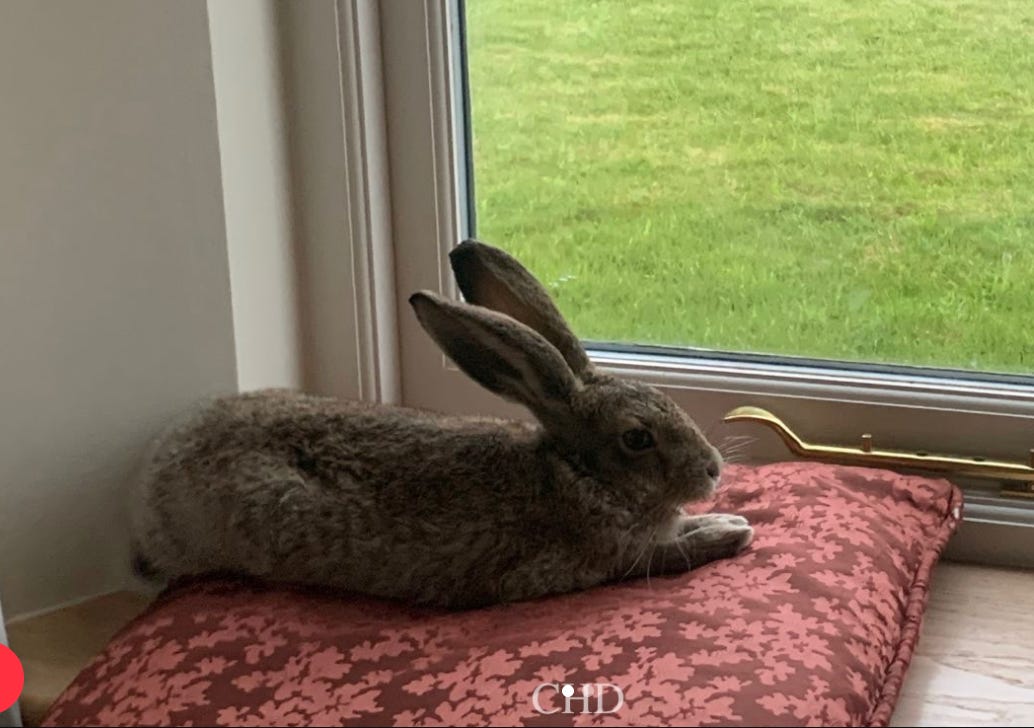
Dalton observes everything, or so it seems. She does not exaggerate anything. Emotions emerge from below, so to speak. Nothing is hyped. Her prose is calm and precise. (She does not give the leveret a name; she respects its wildness.)
So: “The animal, no longer than the width of my palm, lay on its stomach with its eyes open and its short, silky ears held tightly against its back. Its fur was dark brown, thick and choppy, and grew in delicate curls along its spine. Long, pale guard hairs and whiskers stood out from its body and glowed in the weak sun, creating a corona of light around its rump and muzzle.”
There is immense tenderness in the book, the tenderness that is reflected in, and that comes from, close attention to details. The book is quiet too, which makes everything go deeper into the reader, and stay there.
Its very quiet makes room for the reader, somehow. The book is elegiac. (If you haven’t heard the word "leveret” before, it will stick in your mind, maybe forever. It’s kind of musical, or so it seems to me, having read Dalton. Say it? See, at all?)
It’s an indescribably moving book. It makes you see a lot of things differently. A major reason is its restraint.
2
At the University of Chicago, I was lucky enough to know Wayne Booth, the great English professor. Booth explored the “implied author” of texts and also “the company we keep” whenever we read something.
The implied author is the person who seems to lie behind the text, who may or may not be anything like that person is real life. Dalton has a transcendent implied author. Tyler Cowen has a terrific implied author: curious, witty, kind, mischievous, never mean, occasionally pointed.
Some recent U.S. presidents have not had the best imaginable implied author.
Online, some people have horrific implied authors: contemptuous, all-knowing, dismissive, sneering, tribal, smarter-than-thou, full of bile, bitter, a bit brutal, graceless, unfair, sarcastic, without sympathy (except for members of their own tribe, who can do no wrong).
3
Booth also urges that works of literature are a bit like friends, or company, in the sense that we visit with them, and they can poison our emotions and our attitudes toward the world. Alterntively, they can also be uplifting.
Some novels are horrendous company, even if we are drawn to them. One reason may be that they are all hyped up. They yell.
Booth’s chief example is Peter Benchley’s “Jaws.” As the novel starts, Benchley prepares readers for a violent encounter between a woman (who has recently “thrashed” with her boyfriend in “urgent ardor on the cold sand”) and the “big fish,” the shark, moving “silently through the night water,” with eyes that are “sightless in the back” and “a small, primitive brain.”
Here is Booth’s (terrific) point: By arousing the reader with the prospect of violence and by reveling in the “bloody adventure, the story at each step molds me into its shapes, giving me practice, as it were, in wanting certain outcomes and qualities and ignoring certain others. I become, for the hours of reading, that kind of desirer” (my italics).
Right.
As excellent company, Booth points to William Butler Yeats’s “The Fiddler of Dooney.” As Yeats writes, St. Peter will call the fiddler quickly through heaven’s gate: “And when the folk there spy me / They will all come up to me / With ‘Here is the fiddler of Dooney!’ / And dance like a wave of the sea.”
It’s not exactly modest to say that you’ll zoom right through heaven’s gate. But there’s such joy and delight in the poem, and such contagious exuberance, that readers feel that they are themselves dancing to Yeats’s fiddle.
4
(a) “The Supreme Court consists mostly of partisan hacks.”
(b) “Stephen Curry is not just the greatest basketball player in history. He is the greatest athlete - period.”
(c) “Liberalism is a mental disorder.”
(d) “No philosopher in the last 100 years can hold a candle to Christine Korsgaard.”
These are examples of hyperbole. We can find a lot of hyperbole on social media. Much of it involves politics; see (a) and (c).
(Just seen on x as I was writing this: “Modern Supreme Court doctrine is easy to understand: - if it helps Republicans, it’s legal. - if it hurts Republican [sic], it’s illegal.”)
(Illuminated by Booth: The not-wonderfulness of online comments that take form of, “Short version [of Jones]: [followed by some idiotic view that Jones does not hold].”) As in, “Short version of John Rawls: Traditions stink.”)
Hyberbolic statements are usually false. All of the statements above (a, b, c, and d) are false, in my view. But the context matters. For example, (a) and (c) might not be said or received as literal truths. They might be meant to illustrate something.
(Thus: “The Feast of Love by Charles Baxter? The greatest book ever written. As in, ever.”) (Note: This is a genuinely great book, but maybe not the greatest book ever written.)
5
There is negative hyperbole, as in (a) and (c), and there is positive hyperbole, as in (b) and (d). Negative hyperbole can be cruel. Positive hyberbole can be kind. Some people favor negative hyperbole and avoid positive hyperbole. (It’s good to stay away from them.) Some people are just hyperbolic. Some people favor positive hyperbole and avoid negative hyperbole. (I like those people.) Some people are just calibrated. They avoid hyberbole of all kinds.
Hyperbole comes from a certain kind of implied author, though what kind depends on the nature, extent, and direction of the hyperbole. Much of the time, the implied author of hyperbole is exuberant, confident, gleeful, and dogmatic.
With respect to negative hyperbole, this is good from Taylor Swift:
And I can see you years from now in a bar
Talking over a football game
With that same big, loud opinion
But nobody’s listening
Washed up and ranting about the same old bitter things
Drunk and grumblin’ on about how I can’t sing
6
Hyperbole can be energizing. It can be seductive. It can be joyful. It can be gleeful. It can make people feel bigger. It can lift the day. But it is also really noisy. It can make people a little bit hysterical, and a little bit crazy.
I prefer this, from Dalton: “The leveret changed before my eyes in other ways. . . . When its paws were tucked up underneath it, it still looked small — but when it stood up on its hind legs to lean against a window it was roughly fifteen inches long from the tip of its legs to its front feet, resting against the glass, lean and powerful.”
I feel that hyperbole is a kind of double rounding. Rounded once for one's own uncertainty in the assertion, and rounded twice for the agency of the listener to resist it.
This might also be a subtle kind of double counting, if and when we use our own uncertainty as the template to anticipate the listener's.